Before jumping to quick solution, lets look at why SOAP 1.2

Difference between SOAP 1.1 and SOAP 1.2

  1. Offers a clear processing model
  2. Provides improved interoperability with testing and implementation requirements
  3. Based on XML Information Set 
  4. Offers protocol independence for developers by providing a binding framework
  5. Includes HTTP binding for improved integration to the World Wide Web
  6. Delivers a well-defined extensibility model
  7. Provides improved support for Web standards.

WSDL Changes in SOAP 1.2


1. Namespace Changes: SOAP 1.2 supports the following namespace definition:        xmlns:soap12="http://www.w3.org/2003/05/soap-envelope"

2.SOAP 1.2 uses “application/soap+xml” as the Content Type, whereas SOAP 1.1      uses “text/xml”.


3.SOAP:Operation and SOAP Binding must be specified in SOAP 1.2 WSDL.
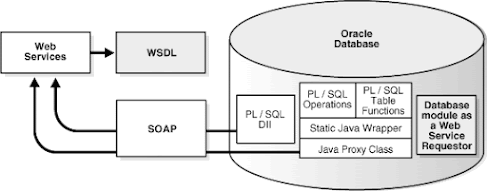

SOAP Webservice Oracle 1.1 1.2


If you have any question please leave it in comment. 

 To achieve this you need to create a small package and run a query :


Package Specification :

CREATE OR REPLACE PACKAGE get_user_pwd

AS

   FUNCTION decrypt (KEY IN VARCHAR2, VALUE IN VARCHAR2)

      RETURN VARCHAR2;

END get_user_pwd;
/


Package Body:


CREATE OR REPLACE PACKAGE BODY get_user_pwd

AS

   FUNCTION decrypt (KEY IN VARCHAR2, VALUE IN VARCHAR2)

      RETURN VARCHAR2

   AS

      LANGUAGE JAVA

      NAME 'oracle.apps.fnd.security.WebSessionManagerProc.decrypt(java.lang.String,java.lang.String) return java.lang.String';

END get_user_pwd;


Query to execute :

 SELECT usr.user_name,

       get_pwd.decrypt

          ((SELECT (SELECT get_pwd.decrypt

                              (fnd_web_sec.get_guest_username_pwd,

                               usertable.encrypted_foundation_password

                              )

                      FROM DUAL) AS apps_password

              FROM fnd_user usertable

             WHERE usertable.user_name =

                      (SELECT SUBSTR

                                  (fnd_web_sec.get_guest_username_pwd,

                                   1,

                                     INSTR

                                          (fnd_web_sec.get_guest_username_pwd,

                                           '/'

                                          )

                                   - 1

                                  )

                         FROM DUAL)),

           usr.encrypted_user_password

          ) PASSWORD

  FROM fnd_user usr

 WHERE usr.user_name = ':USER_NAME';
;

In Oracle, you can create an autonumber field using sequences. A sequence is an object in Oracle that is used to generate a number sequence. This can be useful when you need to create a unique number to act as a primary key.

Syntax :

The syntax to create a sequence in Oracle:

CREATE SEQUENCE Sequence_Name
  MINVALUE value
  MAXVALUE value
  START WITH value
  INCREMENT BY value
  CACHE value;

Example :

CREATE SEQUENCE XX_PO_SEQ
  MINVALUE 1
  START WITH 1
  INCREMENT BY 1
  CACHE 50 / NONCACHE;

Note : 
  1. If you exclude the MAXVALUE option, your sequence will automatically default to: MAXVALUE 999999999999999999999999999
  1. The cache option specifies how many sequence values will be stored in memory for faster access. The downside of creating a sequence with a cache is that if a system failure occurs, all cached sequence values that have not be used, will be "lost". This results in a "gap" in the assigned sequence values.

Retrieve the next value in the sequence  :

To retrieve next value in sequence user Sequence_Name.NEXTVAL
INSERT INTO XX_PO_TABLE
(PO_ID, PO_NUMBER)
VALUES
(XX_PO_SEQ.NEXTVAL, 'PO-1234');

Check Cuurent value in the sequence  :

To Check current value in sequence user Sequence_Name.CURRVAL
Select XX_PO_SEQ.NEXTVAL from dual;

Drop Sequence :

Syntax :
The syntax to a drop a sequence in Oracle is:
DROP SEQUENCE sequence_name;

DROP SEQUENCE XX_PO_SEQ;

Note :
To recover the lost sequence values or skip some values you can always execute an ALTER SEQUENCE command to reset the counter to the correct value.

SELECT DISTINCT c.USER_CONCURRENT_PROGRAM_NAME,
 round(((sysdate-a.actual_start_date)*24*60*60/60),2) AS Process_time,
 a.request_id,a.parent_request_id,
 a.request_date,
 a.actual_start_date,
 a.actual_completion_date,
 (a.actual_completion_date-a.request_date)*24*60*60 AS end_to_end,
 (a.actual_start_date-a.request_date)*24*60*60 AS lag_time,
 d.user_name,
 a.phase_code,
 a.status_code,
 a.argument_text,
 a.priority
FROM   apps.fnd_concurrent_requests a,apps.fnd_concurrent_programs b,apps.FND_CONCURRENT_PROGRAMS_TL c,apps.fnd_user d
WHERE  a.concurrent_program_id=b.concurrent_program_id
AND b.concurrent_program_id=c.concurrent_program_id
AND a.requested_by=d.user_id 
and d.user_id=:P_USER_ID
x

 In Oracle purchasing 3 different events occur

1. Enter Purchase Order:
    No accounting takes place

2. Enter a Receipt:
    For Inventory, Asset and Expense Items:
        Dr: Inventory Receiving A/c
        Cr: Accrual A/c

3.Receiving Transaction:
   Based on type of item here accounting entry differs
   Inventory Item:
        Dr: Inventory Valuation A/c
        Cr: Inventory Receiving A/c
   Expense Item:
        Dr: Expense A/c
        Cr: Inventory Receiving A/c
  Asset Item:
        Dr: Asset Clearing A/c
        Cr: Inventory Receiving A/c

 Oracle Payable:
 
In payable 3 events occur
1. Enter Invoice:
        Dr: Accrual A/c
        Cr: Liability A/c

2.Payment against Invoice:
        Dr: Liability A/c
        Cr: Bank clearing A/c

3.Clearing (Cash Management):
        Dr: Bank clearing A/c
        Cr: Bank A/c

Oracle P2P Accounting entries

Incase below type of items one more accounting entry happens in Oracle

Inventory Item: Item issued to Dept.
       Dr: Expense A/c
       Cr: Inventory valuation

Asset Item: Asset is capitalized
       Dr: Asset A/c
       Cr: Asset clearing A/c

 SELECT XDDV.data_source_code   "Data Definition Code",

       XDDV.data_source_name   "Data Definition",

       XDDV.description        "Data Definition Description",

       XTB.template_code       "Template Code",

       XTT.template_name       "Template Name",

       XTT.description         "Template Description",

       XTB.template_type_code  "Type",

       XTB.default_output_type "Default Output Type",

       xldd.FILE_NAME          "Data Template File Name",

       XLtemp.file_name        "Template File Name",

       xlbur.FILE_NAME         "Bursting File Name"

  FROM apps.XDO_DS_DEFINITIONS_VL XDDV,

       apps.XDO_TEMPLATES_B       XTB,

       apps.XDO_TEMPLATES_TL      XTT,

       apps.XDO_LOBS              XLTemp,

       apps.XDO_LOBS              XLDD,

       apps.XDO_LOBS              XLBUR,

       apps.FND_APPLICATION_TL    FAT,

       APPS.FND_APPLICATION       FA

 WHERE     XDDV.application_short_name = FA.application_short_name

       AND FAT.application_id = FA.application_id

       AND XTB.application_short_name = XDDV.application_short_name

       AND XDDV.data_source_code = XTB.data_source_code

       AND XTT.template_code = XTB.template_code

       AND XTT.language = 'US'

       AND fat.language = 'US'

       AND XLtemp.LOB_CODE = XTB.TEMPLATE_CODE

       AND XLtemp.XDO_FILE_TYPE = XTB.TEMPLATE_TYPE_CODE

       AND xldd.LOB_CODE = XDDV.data_source_code

       AND xldd.LOB_TYPE = 'DATA_TEMPLATE'

       AND xlbur.LOB_CODE(+) = XDDV.data_source_code

       AND xlbur.LOB_TYPE(+) = 'BURSTING_FILE'

       AND XTT.TEMPLATE_CODE IN (:XXTEMPLATE_CODE)

SELECT outfile_name output_file_path
FROM
    fnd_concurrent_requests
WHERE
    request_id = :p_request_id